Your Nearest Creek Is a Retreat Center: The Case for the Ten-Minute Pilgrimage
Let me say the quiet part up front: I think the wellness industry has sold us a lie about scale. The lie says transformation is expensive and far away — a silent retreat in Joshua Tree, a month in a Costa Rican jungle, at minimum a weekend with a sound bath and a branded journal. And for some seekers, at some seasons, those things are genuinely worth it.
But I've watched people have more profound shifts in eleven minutes on a tree-lined block in Dayton than I've seen in a week of curated silence. The barrier was never distance. The barrier was the belief that the sacred requires a passport.
The Micro-Adventure Movement Is Onto Something
There's a growing contingent of outdoor folks — hikers, thru-walkers, weekend adventurers — pushing back against the idea that adventure must be epic. They call it micro-adventuring: small, spontaneous, local excursions that fit inside ordinary life. Sleep in the backyard. Watch sunrise from the water tower hill. Take the long way to the drugstore.
What the movement frames as recreation, I'd argue is actually contemplative practice wearing hiking boots. Because here's what a micro-adventure does that a regular Tuesday doesn't: it breaks the pattern. It inserts novelty, low stakes, and unstructured attention into a life otherwise governed by notifications and route memorization.
What the Science of Tired Brains Suggests
Attention restoration theory — developed by environmental psychologists Rachel and Stephen Kaplan — holds that the directed attention we spend all day on screens and spreadsheets is a finite resource that depletes like a muscle. Natural environments, even modest ones, engage the mind in what researchers call soft fascination: clouds moving, water riffing over stones, a squirrel making questionable decisions. This lets the depleted attention system quietly rebuild.
You don't need wilderness for this. Studies have found measurable benefits from urban green space, tree-lined streets, even views of a single tree from a window. The Japanese practice of shinrin-yoku — forest bathing — works in a municipal park. The dose matters less than the quality of attention you bring.
The Week of Small Pilgrimages
A pilgrimage, traditionally, is a journey with sacred intent — the destination matters less than the walking itself. So here's my challenge: seven days, seven micro-pilgrimages, all within one mile of home.
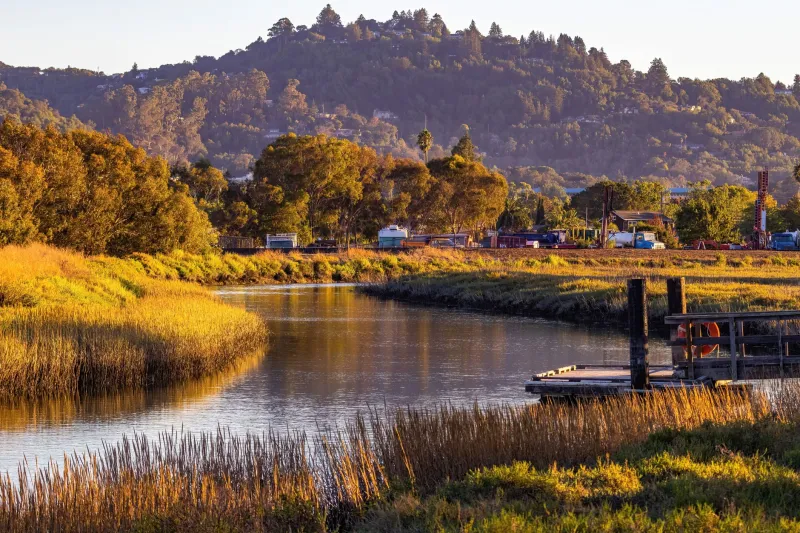
Day one: the creek or the ditch. Every town has water if you look — a creek, a storm drain with ambitions, a retention pond with ducks. Sit near it for ten minutes. Do nothing else.
Day two: the oldest tree. Find the largest or oldest tree in your walkable radius. Put your hand on the bark. Yes, really. Neighborhood watch can cope.
Day three: the edge. Walk to the boundary of your neighborhood — where the sidewalk ends, where the field starts, where the map gets vague. Edges are liminal spaces, and liminal spaces are where the inner life gets talkative.
Day four: dawn or dusk only. Same route as always, but at the hour when the light goes strange. Liminal time, liminal place. Notice what surfaces.
Day five: the no-phone pilgrimage. Leave the device. Yes, all of it. Ten minutes of being unreachable is a radical act in 2020s America.
Day six: the stranger's view. Walk your usual route backward, or take streets you've never turned down. Familiar territory seen from a new angle re-trains the seeing eye.
Day seven: give something. Leave a painted rock, pick up litter, water the struggling tree on the corner. Pilgrimage completes when it turns outward.
Why This Actually Works
The retreat model works partly because it removes you from your context. The micro-pilgrimage works because it re-enchants your existing context — and that's a more durable magic. If stillness only lives at the monastery, it's hostage to your travel budget. If it lives at the drainage creek behind the Kroger, it's available every single day for the rest of your life.
The mystics have said this forever in fancier language: the kingdom is spread upon the earth, and we do not see it. Turns out you can see it in ten minutes, on foot, within a mile of your front door. Go find your creek. It's been waiting.