Where the Sacred Lives: Carving Out a Threshold to Stillness in an Ordinary American Home
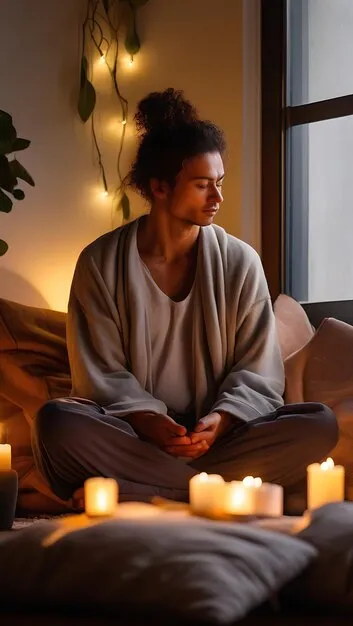
Photo: cozy meditation corner with candle and cushion in small apartment, via img.freepik.com
There's a quiet myth that keeps a lot of us from ever starting a practice: the idea that the sacred lives somewhere else. In a monastery. In a retreat center tucked into the red rocks of Arizona. In a place that requires a plane ticket, a sabbatical, or at the very least a spare room we don't currently have.
But here's the older truth, the one mystics across traditions have whispered for centuries: the sanctum is not a location. It's a state of mind — one that happens to love a physical doorway.
And a doorway can fit anywhere. Even in a 450-square-foot studio in Chicago.
Why a Physical Threshold Matters
You might wonder why we need a designated spot at all. Can't we just... meditate on the couch?
Sometimes, sure. But the mind is a creature of association. When you return to the same chair, the same candle, the same small arrangement of objects day after day, something shifts. Your nervous system begins to recognize the signal: we're crossing over now. The commute from your kitchen to your corner becomes a pilgrimage of twelve feet.
That's the real function of a home sanctum. Not decoration — threshold-making. You're drawing a line in the carpet and saying, on this side, the news doesn't reach me. On this side, the phone is just a rectangle.
Finding Your Corner (Yes, It Exists)
Start small. Honestly, smaller than you think.
- The studio apartment dweller: A windowsill, a shelf above your desk, a folding screen that separates a cushion from the rest of the room. Even a dedicated spot on the floor where a mat never gets moved counts.
- The suburban house: You have options — a guest room corner, the landing at the top of the stairs, a garage nook. Resist the urge to make it a whole room right away. Intimacy beats square footage.
- The shared space: A rolling cart or a beautiful wooden box can hold your ritual objects and tuck away when needed. Sacred doesn't have to mean permanent.
What matters isn't size. It's consistency. Pick one place and let it become yours.
The Four Sensory Keys
A sanctum speaks to the senses before it ever speaks to the mind. Here's how to build yours, one sense at a time.
Light
Candlelight is the classic for a reason — a living flame holds attention the way no screen can. If open flames aren't practical (rentals, kids, cats named Chaos), a salt lamp or a dim, warm bulb works. The goal is to change the light. Different light, different state.
Sound
Some of us need silence. Others need a bowl tone, a soft drone, rain on a speaker, or a wind chime by an open window. Experiment. Notice what helps your mind settle instead of wander. One small speaker or one singing bowl — that's all it takes.
Scent
Smell is the fastest road to memory and mood. Incense, essential oils, a beeswax candle's honeyed warmth, even the cedar of a wooden box you open every morning. Choose one scent and reserve it for this space only. Over time, that fragrance alone will start dropping you into stillness before you've even sat down.
Symbolism
This is the mystical heart of it. Choose one or two objects that mean something to you: a stone from a meaningful trip, a tarot card, a small statue, a grandmother's rosary, a feather, a bowl of water. You don't need to follow any tradition faithfully — you need objects that stop you in your tracks for half a second. That half-second is the door opening.
Protecting the Space from Modern Life
Here's the hard part, and it has nothing to do with candles.
The modern home is a battlefield of pings, notifications, and half-finished to-do lists. Your sanctum will only work if you defend it like it matters — because it does.
- The phone stays outside the threshold. Not face-down. Another room.
- Tell the people you live with. A simple "this corner is my quiet time, I'll be back in fifteen minutes" does more than any do-not-disturb sign.
- Don't turn it into a to-do zone. No bills, no laptop, no journaling about your stress inventory (save that for elsewhere). Let the space stay uncluttered in purpose, not just in appearance.
- Expect interruptions. Kids will wander in. The dog will sit on your cushion. The sacred isn't fragile — it survives a toddler. Come back to the threshold and cross it again.
The Practice of Crossing Over
Once your space exists, the ritual is simple. Light the candle or open the box. Sit. Take three breaths. Notice the scent, the sound, the light.
That's it. That's the whole ceremony on day one.
Over weeks, the crossing deepens on its own. The objects become old friends. The twelve-foot pilgrimage becomes the most familiar journey in your life — and strangely, the one that takes you farthest.
Because you were never really building a corner of a room. You were building a doorway inward. And the sanctum, as it turns out, was within reach the whole time.